Written by: Molly Stanley
Couples often come to relationship counseling wanting to work on “communication.” They are caught in painful cycles where they are struggling to hear each other—often hurting each other and feeling hurt and unseen in the process.
What perpetuates these cycles?
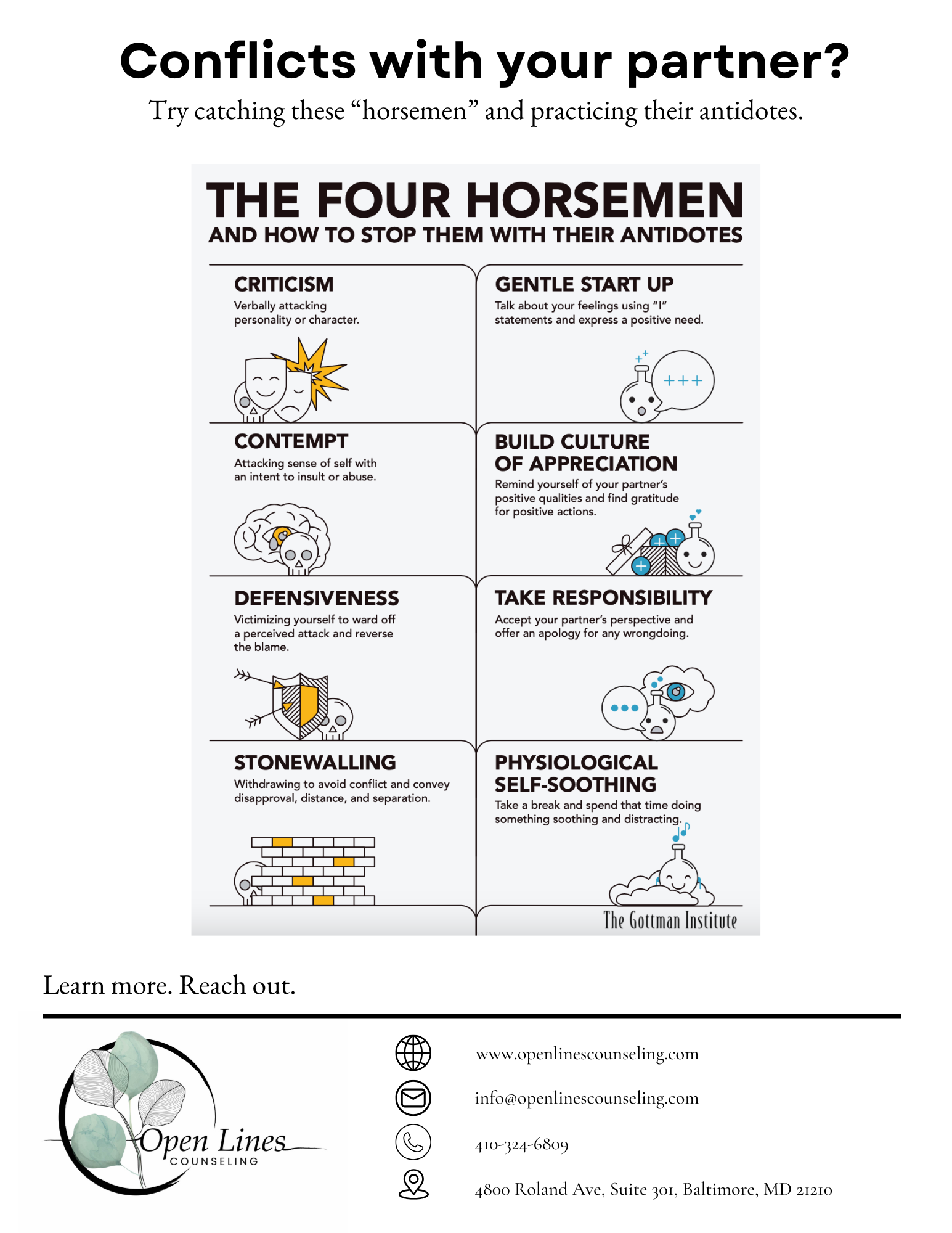
Drs. John and Julie Gottman, founders of Gottman Method (an effective, research-backed approach to couples therapy), noticed four common harmful communication patterns in their decades of research. They call them the Four Horsemen of Relationships, which refers to criticism, contempt, defensiveness, and stonewalling, and propose four corresponding “antidotes.”
Having an understanding of how these communication pitfalls show up in conflict allows for the antidotes, or solutions, to be implemented to keep them at bay.
Listed below are the definitions of each (with examples), as well as the antidotes. It is important to note that these approaches to conflict in a relationship have likely taken months or years to establish, so it will take time to lean into the antidotes fully before it feels more natural. It takes intentional practice to diminish these horsemen.
CRITICISM
This is when a partner has a complaint about the other person’s behavior but attributes that complaint to a failing in the receiving partner’s character or personality. Something to mention with criticism is that we can feel criticized (which is very valid); however, that does not always mean, by definition, that our partner has criticized us. It would be important to further process what led to the feeling of being criticized, what other emotions are arising from the complaint, and how to move forward together in having a dialogue about the complaint without getting stuck.
Example: One partner works from home and was unable to do the dishes that were in the sink. The other partner comes home from work and says, “Look at all these dishes in the sink. You are so lazy.”
Antidote: The Gottmans state that the antidote to criticism is a gentle start-up. This consists of using “I” statements and not resorting to blame. For the person with the complaint, make sure to use emotion words (i.e., frustrated, concerned, sad, etc.) and try to avoid using the word “you” because that can lead to blame and potential defensiveness in the receiving partner. Using a gentle start-up in this situation could be: “I feel frustrated after my day at work and was not expecting to see dishes in the sink. Could we talk more about this and find a solution together?”
CONTEMPT
This refers to being disrespectful, mean, and/or not approaching one’ partner with empathy. Tone and volume of voice can also contribute to displays of contempt.
Example: In the same example provided above, this could look like the partner yelling in a mean tone, “I’m tired of you being such a loser. I can’t believe I married you and gave you all these years of my time.”
Antidote: Contempt can be resolved through mindfulness of how we are responding and filtering our immediate thoughts. Thinking before speaking is especially important in these situations and can go a long way in increasing connection, allowing for repair, and feeling heard. Even outside of specific instances where contempt may show up, it can be helpful to give your partner appreciation and affection as part of a routine in the relationship. This can increase the positive perspective one can have of their partner.
DEFENSIVENESS
This occurs when a partner will explain their reasoning behind doing something that their partner brings up to them. Instead of validating their partner’s experience, the approached partner will come up with excuses or explain away the situation. This can be because the partner may feel blamed or guilty. This can also lead to the defensive partner bringing up times they have felt hurt by their partner, which leads to a lack of resolution of the original problem.
Example: Continuing with the above example, a defensive partner may respond, “Well, I’ve been busy all day, and you never do the dishes when you’re home, either. Because you were working, I had to take the kids to school and take the dog for a walk. That doesn’t give me much time to think about the dishes.”
Antidote: The antidote to defensiveness is taking responsibility. This can look like acknowledgement of what our partner is saying, admitting our behavior, and not blaming our partner. Defensiveness can lead to more defensiveness from our partner, which can throw the interaction into a cycle of conflict.
STONEWALLING
This is characterized by shutting down during discussions. This may occur intentionally or unintentionally. Typically, it is a stress response (flight or freeze) to a difficult conversation, but it could also be used on purpose to end an unwanted conversation.
Example: Using the above example, in response to the partner’s defensiveness, the other partner may just get up and leave the room without communicating what they are thinking and why they are leaving the conversation.
Antidote: For people who may become emotionally flooded during difficult conversations and shut down, it would be important to prepare with one’s partner(s) of how one could emotionally self-regulate. This could include deciding how to initiate a break and then re-initiate the conversation at a later time. For the person who shuts down, having self-regulating coping strategies for feeling overwhelmed would be beneficial to use during the break from the conversation.
As described, the Four Horsemen of Relationships can lead to specific conflict cycles that can be difficult to break. Beginning to utilize the antidotes may start to shift those patterns to more positive interactions and lead to quicker repair.
A couples therapist can further assist in identifying conflict cycles as well as incorporating antidotes. Both Melissa and Molly at Open Lines Counseling provide couples counseling, utilizing the Gottman Method.